The Chronicle of Higher Education, one of our resources for insight into the well-being (or lack) of the academic job market, is in the process of launching a new column, "Vitae," exploring the vicissitudes of the market and the professional skills needed to navigate it. A recent column "Advice for Graduate Students" provided a refreshing change of pace from the more detail-oriented articles about how to tailor your cover letter or how to strategize campus visits when you have childcare concerns, highlighting instead a big-picture state of mind that helps us keep our studies and research and job search in perspective.
One caveat: It would be easy to take the author's reflections as platitudes, but I think that she is offering an important observation, that our psychological well-being is an important part of our professional toolbox and appeal as a candidate. In our search for the minutiae that will help us nail down that dream job, it's easy to forget the bigger picture of the life of the mind, and the passion that drew us to graduate studies in the first place.
Tuesday, September 3, 2013

Friday, August 2, 2013
What we built at OWOT: Serendip-o-matic.
Well, it's been an intense week here at One Week | One Tool, but we've built something, and it works! We're proud to announce the launch of Serendip-o-matic, the serendipity engine where your sources are your search.
The idea is simple: we wanted to restore some of that serendipity-in-the-stacks feeling to the digital research process. As historians, we're used to keyword or subject searching for materials, but with Serendip-o-matic, you can use your own materials — whether a web page, a bibliography, your CV, a paper you've written, or an article you like — as your query. Serendip-o-matic processes your text, extracts a random set of key terms, and returns results from the collections at the Digital Public Library of America, Europeana, and Flickr Commons. Try it for yourself and see what you get. It's pretty fun.
You can watch the video of our live launch broadcast at One Week | One Tool.

Monday, July 29, 2013
A dispatch from One Week | One Tool.
Hello HoSTM folks! I'm reporting from the field here at the Center for History and New Media at George Mason University, where I'm attending One Week | One Tool, a digital humanities barn raising in which I and eleven other academics, programmers, designers, students, and librarians are working to conceive, design, and implement a digital humanities tool in just under seven days. The first step: figuring out what that tool is going to be.
We had our big brainstorming session this afternoon, and are now opening up the floor to you, the public, to send us your feedback. We've set up a site where you can vote on the potential tools we've come up with, as well as to comment on our ideas. Voting closes at 10 a.m. eastern time tomorrow, Tuesday 30 July 2013, so make your voice heard!
You can follow our progress on twitter by paying attention to #owot.
Tuesday, February 12, 2013
6th Annual CHE Graduate Student Conference - Pictures!

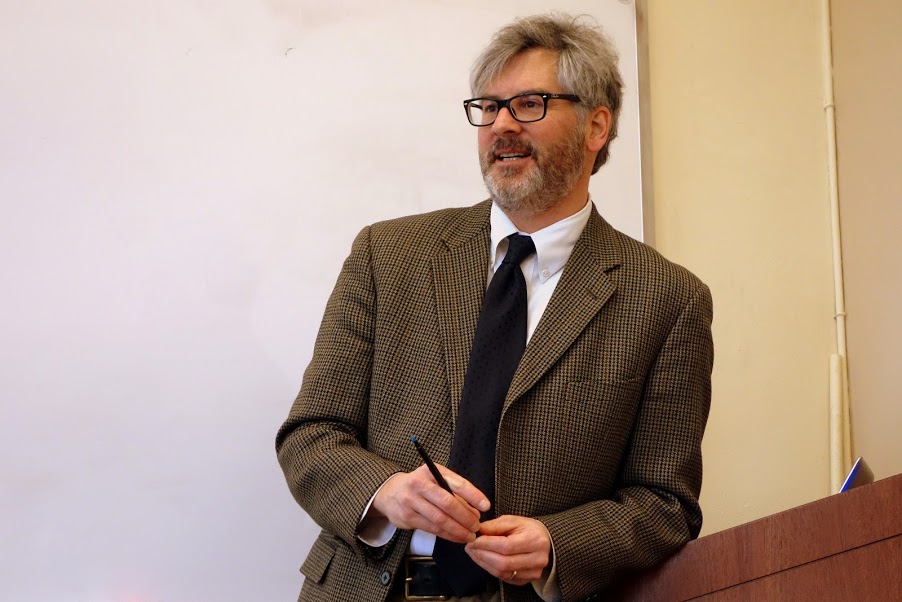 |
| Professor Rick Keller, giving the kickoff address |
 |
| Graduate Student Alex Rudnick presenting on her dissertation proposal |
 |
| Graduate Student Melissa Charenko presenting on Evangelicalism and Environmentalism |
 |
| Hipster Jesus |
 |
| Graduate Student Anna Zeide, Professors Gregg Mitman, Sue Lederer, and Lynn Nyhart |
 |
| The brave souls who made it through the whole day, capping off the conference with a keynote address from recent Geography PhD and current University of Minnesota faculty member, Dr. Abby Neely |
Sunday, February 10, 2013
Fallout: The Mixed Blessing of Radiation and the Public Health

The selection for UW Madison's common reading program this year is Radioactive: Marie and Pierre Curie: A Tale of Love and Fallout by Lauren Redniss. Ebling Library's librarian and curator, affiliate of the department, and always fabulously bescarved Micaela Sullivan-Fowler designed an accompanying exhibit for the Ebling Library Historical Reading Room entitled "Fallout: The Mixed Blessing of Radiation and the Public Health." This past week, the evening of February 7, the Friends of the University of Wisconsin-Madison Library sponsored a tour of "Fallout" with Micaela and a guided discussion hosted by History of Science Department's own Dr. Richard Staley.
Despite the wicked weather, intrepid visitors - many of them Friends of the Library - traced the story of the discovery of radiation and its mixed blessings for public health. Case by case, Micaela told the story of the Curies, the discovery of radioactivity, the initial medical promise (and the consumer products) that x-rays and radium inspired, the practical and professional ramifications of radiation through WWII, and the discovery of the atomic bomb and its use at Hiroshima and Nagasaki. Throughout, Micaela deftly draws out the tensions between the advancing science of radioactivity and its impacts on public health. As in other exhibits, she makes a point of drawing attention to ways that UW was connected to this unfolding history. UW Professor of chemistry Dr. Norria F. Hall, for example, was trained by Marie Curie when he was part of the American Expeditionary Corps in 1919.
Alongside the collection of texts from Ebling's vaults, "Fallout" includes rare objects of material culture from the history of x-ray and radiation technologies, freshly dusted from the basements of UW Hospitals. In addition to the medical apparatus, "Fallout" provides the chance to see The Switch, normally tucked away in University Archives. The Switch comes from Julian Mack of UW's Physics Department, who served as head of the optics unit at Los Alamos and was in charge of photographing the first bomb test. The Switch was used at Los Alamos to turn the power on and off during the explosive work carried out there (note the fantastic big red OFF button). A Special thanks goes to David Null, UW archivist for pulling it out of the University Archives' cabinet of extraordinary objects.

It should be noted that Micaela always puts together a provocative collection of objects and texts in her exhibit work, but she hit this event particularly hard with the awesome stick. First of all, there was swag, and who doesn't like atomic swag? Glow in the dark bracelets, collectible quotes on radioactivity and the atomic age from Pierre and Marie Curie, postcards with the exhibit poster design, and a raffle for x-traordinary copies of Redniss's book, courtesy of the Friends. Visitors toured the cases literally glowing, pockets stuffed, munching on Bomb Shelter Browies and Gamma Ray Grapes, sipping Atomic Punch.

Following the tour, Dr. Staley began the discussion with a few remarks that drew parallels between Micaela's exhibit work on "Fallout" and Redniss's collecting strategies as she prepared to write Radioactive, which she disclosed during her campus visit in October. (Video and transcript of Redniss's visit available here.) Staley touched on the idea of a graphic novel addressing two invisible central themes: love and radioactivity. The discussion noted how the pace of reading changed from page to page, how Redniss guides the story and its themes through the use of visual tools of color, image, typeface. There were, as ever, questions about the sourcing of objects in the exhibit: where they come from, where they are kept, how they cooperate to tell the story of radioactivity and public health.
As a karmic reward for his troubles, Dr. Staley won not one but two raffled copies of Radioactive for the kids. You may not be quite so lucky if you visit the exhibit on your own, but I bet Micaela has a stash of glowing bracelets to wear during your tour. Make the trek to Ebling, whatever the weather, to visit "Fallout: The Mixed Blessing of Radiation and the Public Health."

More information about the exhibit and how to find it is available at the Ebling Library website.
Thursday, January 31, 2013
Sixth Annual CHE Graduate Student Symposium
Many graduate students and faculty in the UW-Madison History of Science Department are also affiliated with CHE (the Center for Culture, Humans, and Environment). We even share a building with them! So, it should come as no surprise that the upcoming CHE Graduate Student Symposium features several of our own. Please join us Saturday, February 9th to here from Professor Keller, Alex Rudnick, Melissa Charenko, and many more. Here is the program:
10:50 20 Minute Break
12:30 Lunch
On your own in Madison
III. INTERPRETING PEOPLE AND PLACE: STORYTELLING IN ENVIRONMENTAL RESEARCH
1:30-2:30
CENTER FOR CULTURE, HISTORY, AND ENVIRONMENT SIXTH ANNUAL GRADUATE STUDENT SYMPOSIUM
9 February 2013 · Science Hall 175
An interdisciplinary showcase of graduate research around issues of culture and environmental change, bringing together history, geography, literature, science, and action.
PROGRAM OF EVENTS
8:30 AM Breakfast
Coffee and bagels provided, Science Hall 175
Symposium Kickoff
9:00 Dr. Richard Keller, Medical History and the History of Science
Coffee and bagels provided, Science Hall 175
Symposium Kickoff
9:00 Dr. Richard Keller, Medical History and the History of Science
“Toward a World History of the Environment”
I. NATURES OF THE STATE
Moderator and Commentator: Brian Hamilton, History
9:30 John Suval, History, “Of Squatters and Statesmen: The Chocchuma Land Sale and the Nature of Jacksonian Democracy”
9:50 Alex Olson, History, “Byzantium’s Eastern Border: Ecology, Mentalities, and the State”
I. NATURES OF THE STATE
Moderator and Commentator: Brian Hamilton, History
9:30 John Suval, History, “Of Squatters and Statesmen: The Chocchuma Land Sale and the Nature of Jacksonian Democracy”
9:50 Alex Olson, History, “Byzantium’s Eastern Border: Ecology, Mentalities, and the State”
10:10 Alex Rudnick, History of Science, “Diets and Landscapes of Deficiency: Pellagra, Sacks of Corn Meal, and Economic Underdevelopment in the American South, 1907-1940”
10:30 Comment and Discussion
10:30 Comment and Discussion
10:50 20 Minute Break
Poster on view:
Kaitlin Rienzo-Stack, Entomology/Holtz Center, and Amy Alstad, Zoology
“If you build it, they will come: testing paradigms of restoration ecology using a historical dataset”
II. IDEOLOGIES AND ENVIRONMENTAL ACTION
II. IDEOLOGIES AND ENVIRONMENTAL ACTION
Moderator and Commentator: Nathan Germain, French and Italian
11:10 Noah Theriault, Anthropology, “Saving Souls, Forests, and Traditions: The (Neo)Colonial Genealogy of a ‘Last Frontier’”
11:30 Melissa Charenko, History of Science, “The Second Coming and Environmentalism: The Historical DebateAbout End Times and Environmental Action Among Evangelical Christians”
11:50 John Porco, History, “Second Growth: Changing Notions of Economic Value in Northern Wisconsin’s Forests”
12:10 Comment and Discussion
11:10 Noah Theriault, Anthropology, “Saving Souls, Forests, and Traditions: The (Neo)Colonial Genealogy of a ‘Last Frontier’”
11:30 Melissa Charenko, History of Science, “The Second Coming and Environmentalism: The Historical DebateAbout End Times and Environmental Action Among Evangelical Christians”
11:50 John Porco, History, “Second Growth: Changing Notions of Economic Value in Northern Wisconsin’s Forests”
12:10 Comment and Discussion
12:30 Lunch
On your own in Madison
III. INTERPRETING PEOPLE AND PLACE: STORYTELLING IN ENVIRONMENTAL RESEARCH
1:30-2:30
Moderator: Kaitlin Rienzo-Stack, Entomology/Holtz Center
1:35 Bethany Laursen, Forestry and Nelson Institute, “The World is Made of Stories of Atoms: Narratives and Networks in Driftless Area Landscape Governance”
1:45 Amanda McMillan, Community and Environmental Sociology, “Ghosts of Farming Past and Future: Narrative and the Graying of Agriculture”
1:55 Kara Cromwell, Limnology, “Telling Science Stories: When It Gets Ugly”
1:35 Bethany Laursen, Forestry and Nelson Institute, “The World is Made of Stories of Atoms: Narratives and Networks in Driftless Area Landscape Governance”
1:45 Amanda McMillan, Community and Environmental Sociology, “Ghosts of Farming Past and Future: Narrative and the Graying of Agriculture”
1:55 Kara Cromwell, Limnology, “Telling Science Stories: When It Gets Ugly”
Comment and Discussion
Keynote Address
2:45 Dr. Abby Neely, University of Minnesota, Geography, Environment and Society
Keynote Address
2:45 Dr. Abby Neely, University of Minnesota, Geography, Environment and Society
“Research and Writing Through Teaching”
3:30 Reception, Science Hall 175
Saturday, December 1, 2012
HSS 2012
UW-Madison's History of Science, Medicine, and Technology program was well represented at the History of Science Society Meeting in San Diego this year. We had many alumni and current students presenting, so we organized a little dinner before the Graduate and Early Career Caucus mixer on Friday night. From left to right: Camilo Quintero, Megan Raby, Dana Freiburger, Paul Erikson, Matt Lavine, Meridith Beck-Sayre (hiding behind Bridget Collins), and Andrew Stuhl.

Monday, October 15, 2012
HSS Climate Survey
 |
| www.toothpastefordinner.com |
I strongly support this action and I hope you'll take the time to complete the survey. I found the process of responding to be a really enlightening process. I found myself thinking in a broader way about the challenges that face our field and about the cultures of annual professional meetings. Although I enjoy and have found HSS meetings very productive, I definitely think there is room for improvement. Although the history of science supports diverse viewpoints, it is no secret that in other areas, particularly racial diversity, our homogeneity is plain to see. The Graduate Student and Early Career Caucus has done a great job improving the experience for more junior members of our society, but more efforts in this direction are also needed and, I think, would complement efforts toward increasing diversity. I was impressed by the degree to which the survey solicited written responses for clarifications and further thoughts, and I know those involved in putting it together would appreciate as full a response as possible.
Many thanks to Georgina Montgomery and our own alumna Erika Milam for spearheading this effort as the co-chairs of the Women's Caucus, and to Lynn Nyhart and the Executive Committee for their sponsorship. Many thanks as well to the graduate students who helped to organize and provide feedback early on, including our own Meridith Beck Sayre and Scott Prinster.
If you are a new student and have not yet joined HSS, there's no time like the present!
Sunday, October 14, 2012
Kepler in Space
Just wanted to share my first blog post over on my website. Did you know that space travel was a popular theme in early-modern fiction?
Friday, October 5, 2012
Sneaky CAPTCHA images contribute to the digitization effort
Recognize this image? Of course you do.

These goofy CAPTCHA images serve as the gatekeeper on many websites such as Facebook, Amazon, and Ticketmaster. Part of their function is to prove that the user is a human rather than a spamming computer, but thanks to the work of Luis von Ahm, a computer scientist at Carnegie Mellon, the CAPTCHA is also contributing to the digitization of books and periodicals. Somehow I hadn't heard about this additional function, although I've filled out perhaps hundreds of these little boxes in the past several years... I blame my dissertator tunnel vision for this.
Despite advances in Optical Character Recognition (OCR), computers are not yet able to match the human mind's amazing ability to recognize symbols such as text, even when they are inconsistent, distorted, or poorly reproduced. Von Ahm has developed a version of the CAPTCHA program, called reCAPTCHA, in which the user is asked to type in two words instead of one. One of these words serves to confirm that the user is human, but the other is an image from a book or periodical, and our response helps to translate the image into text. Several users are given the same image, and if they consistently interpret the image as the same word, it is considered successfully converted to text.
Here's an article from the NPR website with more information about this program: http://www.npr.org/templates/story/story.php?storyId=93605988
and also an article in <i>Science</i>:
http://www.sciencemag.org/content/321/5895/1465.full?sid=e16c1bda-edda-462d-9198-baa2096672f9
Friday, August 31, 2012
Oh, Henrietta, we can live on forever...
I just became aware of a musical tribute to Henrietta Lacks, the subject of last year's Go Big Read book The Immortal Life of Henrietta Lacks and a figure important to the history of science and medicine. The group Yeasayer (who describe themselves as "Middle Eastern-psych-snap-gospel") has written a song called "Henrietta." I think it's quite good and I applaud the band for making a tribute to her.
Monday, July 9, 2012
The Higgs Boson walks into a church...
Here at the University of Wisconsin, we have a lot of grad students and professors who study science and religion — most famously Ron Numbers and his many students, of whom the two current ones are the accomplished Dana Freiburger and the ecumenical Scott Prinster.

All three gentlemen should probably now dispense the standard church pun-ishment upon me. (I personally grew up atheist, so I have no idea what kind of trouble I'm in for.)
Congratulations, also, to all the hardworking physicists and engineers (you're welcome, Peter Galison) on the discovery of the particle-that-is-statistically-consistent-with-the-Higgs boson! We celebrate your great accomplishment by rejoicing in your use of Comic Sans in science.
(Image credit: it's floating around on facebook, but I can't find the original attribution. I'm not sure memes can have original attribution these days, but that's a whole other blog post...)

All three gentlemen should probably now dispense the standard church pun-ishment upon me. (I personally grew up atheist, so I have no idea what kind of trouble I'm in for.)
Congratulations, also, to all the hardworking physicists and engineers (you're welcome, Peter Galison) on the discovery of the particle-that-is-statistically-consistent-with-the-Higgs boson! We celebrate your great accomplishment by rejoicing in your use of Comic Sans in science.
(Image credit: it's floating around on facebook, but I can't find the original attribution. I'm not sure memes can have original attribution these days, but that's a whole other blog post...)
Saturday, June 9, 2012
History of Science films of note: Isaac Newton, Zombie Hunter

No word yet on whether Shia Labeouf has been tapped for the role of Isaac Newton.
I guess historians of science like doing historical reenactments, like Captain Cook's 1768 expedition to observe the transit of Venus — but it's important to remember that we don't have a monopoly on doing history! According to The Hollywood Reporter, Rob Cohen, director of first Fast and the Furious and The Mummy 3: Tomb of the Dragon Emperor, will soon be teaming up with Rocky producer Gene Kirkwood to write and film a new movie based on Isaac Newton. Via The AV Club:
I'm sure that after writing the Principia, Newton needed something better to do, but I kinda doubt that hanging out with a pain in the rear like John Locke was one of them. On the other hand, if this upcoming movie is anything like Troy, we might want to make this required viewing for undergrad SciRev classes — with a shot whenever Newton's heterodox religion gets cut out of the script, or at least whenever we get to see Brad Pitt's pecs.“Cohen's story will focus on Newton's later years as the head of the Royal Mint, with his film casting Newton as a ‘detective’—perhaps one aided by Newton's older partner John Locke, as sort of an Enlightenment-age Lethal Weapon—with Newton devoting himself primarily to hunting down counterfeiters (and, should Cohen show any interest in actual history, slowly falling apart thanks to a system ravaged by alchemy-provoked mercury poisoning). ”
sources: THR, The AV Club, Lists of Note
image credit: National Geographic, The Michael Bayifier
Thursday, June 7, 2012
Transit of Venus
Although we did not travel to Tahiti, several graduate students and faculty members did gather on the shore of Lake Mendota this Tuesday to try and observe the Transit of Venus. Venus passes in front of the sun periodically, with pairs of transits 8 years apart occurring approximately every 120 years. The most recent transit was in 2004, which meant this was the last opportunity in our lifetimes to witness it.
Aside from being a rare astronomical phenomenon, the Transit of Venus is significant for historical reasons. By combining precise observations of the Transit from multiple sites around the Earth, astronomers in the 17th and 18th centuries hoped to use the principle of parallax to calculate the distance between Venus and the Earth. If this distance could be determined, then the distances of all the planets from the Sun could be calculated using Kepler's law relating the period of a planet's orbit to its distance from the sun [video]. That is to say, scientists would finally know the absolute size of the solar system.
Scientists and explorers from Europe and America mounted expeditions to the far corners of the world to observe the transits of 1761 and 1769. This included the famous first voyage of James Cook, who set out from England to sail around South America at Cape Horn before heading on to the island of Tahiti in the South Pacific. After 8 months at sea, Cook and the scientific observers reached Tahiti and established a small observation post. After successfully recording their data, Cook and his crew continued on to explore the coasts of New Zealand and Australia before gradually making their way through the Indies and around the Cape of Good Hope on their way back to England.
Here in Madison, Mike, Florence, and Robin set up two telescopes at the Memorial Union Terrace. However the weather was mostly cloudy as the transit began. A dinner of beer, bratwurst, and sauerkraut helped our intrepid scholars ward off scurvy while waiting for the clouds to part.

Finally, about an hour into the transit, we began to see gaps in the clouds and sunlight breaking through in the west. As the sun came into view Mike and Florence quickly re-calibrated the telescopes.

One telescope had a solar filter that allowed viewers to look directly at the Sun and Venus, while the second telescope projected the image of the transit onto a sheet of paper.


As the clouds came and went, we attracted crowds of interested passers-by. People were grateful to have a chance to view the transit, and we all had a blast!
Click here for a full slideshow of the event.
Aside from being a rare astronomical phenomenon, the Transit of Venus is significant for historical reasons. By combining precise observations of the Transit from multiple sites around the Earth, astronomers in the 17th and 18th centuries hoped to use the principle of parallax to calculate the distance between Venus and the Earth. If this distance could be determined, then the distances of all the planets from the Sun could be calculated using Kepler's law relating the period of a planet's orbit to its distance from the sun [video]. That is to say, scientists would finally know the absolute size of the solar system.
Scientists and explorers from Europe and America mounted expeditions to the far corners of the world to observe the transits of 1761 and 1769. This included the famous first voyage of James Cook, who set out from England to sail around South America at Cape Horn before heading on to the island of Tahiti in the South Pacific. After 8 months at sea, Cook and the scientific observers reached Tahiti and established a small observation post. After successfully recording their data, Cook and his crew continued on to explore the coasts of New Zealand and Australia before gradually making their way through the Indies and around the Cape of Good Hope on their way back to England.
Here in Madison, Mike, Florence, and Robin set up two telescopes at the Memorial Union Terrace. However the weather was mostly cloudy as the transit began. A dinner of beer, bratwurst, and sauerkraut helped our intrepid scholars ward off scurvy while waiting for the clouds to part.
Finally, about an hour into the transit, we began to see gaps in the clouds and sunlight breaking through in the west. As the sun came into view Mike and Florence quickly re-calibrated the telescopes.
One telescope had a solar filter that allowed viewers to look directly at the Sun and Venus, while the second telescope projected the image of the transit onto a sheet of paper.
As the clouds came and went, we attracted crowds of interested passers-by. People were grateful to have a chance to view the transit, and we all had a blast!
Click here for a full slideshow of the event.
Friday, June 1, 2012
A Thin Sheet of Reality: The Holographic Principle at the World Science Festival 2011
“What you’re seeing here is an interesting thing…This whole holographic story is the most radical thing that has happened to our understanding of space, time, matter, since the invention of quantum mechanics and relativity.” —Leonard Susskind

This weekend is the 5th annual World Science Festival in New York, whose mission is “to cultivate a general public informed by science, inspired by its wonder, convinced of its value, and prepared to engage with its implications for the future.” In five years it has become one of the premier settings in the United States for the public to engage with science — complete with long lectures, panels, a street fair, and spectacular and esoteric demonstrations of science in action and scientists “at work”.
Last year’s program included a cosmology and physics lecture that caught my eye — a panel on the holographic principle in string theory titled A Thin Sheet of Reality, featuring four of the key contributors of this new speculative theory, Raphael Bousso, Gerard ’t Hooft, Leonard Susskind, and Hermann Verlinde. Briefly, the holographic principle states that all of three-dimensional reality can be described as a two-dimensional sheet or surface of information that extends to the limits of the observable universe, what Bousso calls “a universal relation between geometry [surface area] and information” in spacetime. For now, the caveat is that the holographic principle gives physicists an absolute measure of the quantity of information in a region of space, but the exact form and quality if that information is totally unknown — imagine storing a Whitney Houston (RIP) song on your computer, but then losing that MPEG algorithm that tells the computer how to decode the 0’s and 1’s into soaring vocals and black turtleneck sweaters. The goal for Bousso, ’t Hooft, Susskind, and Verlinde has been to resolve the Hawking black hole information paradox — that quantum information about energy and matter is irretrievably lost inside of a black hole — and in so doing present a unified theory of gravitation, matter, and energy.
If all of this sounds absolutely bat-shit-insane, then you should definitely set aside 90 minutes and watch the panel talk. However, this talk is not just an introduction to a physical theory given by any ordinary physics professor, but also an historical discussion of the development of the theory as told by the physicists who came up with it! Seen this way, lots of cool issues that historians of science might call “science and the public” start to jump out. The first thing is seeing theoretical physicists try to describe a non-intuitive theory to a totally lay audience without mathematics: it takes about an hour for any of it to finally make much sense!
Aside from personal tales of how physics works from the inside (like trying and failing to have an argument with Stephen Hawking), the really good stuff comes at the end of the panel, when the moderator prompts Bousso, ’t Hooft, Susskind, and Verlinde to share their vision of where the holographic principle is going, and why it might be important. ’t Hooft’s imperatives especially, to “ask nasty questions,” are interesting in just how basic his demands are: the restoration of causality and determinacy to quantum mechanics, the subsequent elaboration of the holographic principle to account for dynamics and change over time, and perhaps even a “pre-quantum theory” that describes classical, relativistic, and quantum physics in general! Susskind’s response is classic: “I wouldn’t bet on it!”
Go watch A Thin Sheet of Reality here, and afterwards check out this year's World Science Festival schedule. Don't get lost out there!
Additional reference: Bousso, Raphael (5 Aug 2002). "The holographic principle". Review of Modern Physics 74 (3): 825–874. arXiv:hep-th/0203101. Bibcode2002RvMP...74..825B. doi:10.1103/RevModPhys.74.825
Wednesday, May 23, 2012
Other Blogs for Historians of Science, #12: "Science Minus Details"
Historians of science have it so good, and historians of science also have it oh-so-bad. Obviously, studying and teaching the history of science is pretty awesome. However, when doing (reading, researching, 'riting) history of science we have to understand a lot of...actual science. You know, that thing we write the history of.*
*: Except those unreconstructed social-constructionist historians and sociologists of science.
Fortunately, there are other experts on science too, many of whom are more than happy to help us out in a bind. Many of these experts in science are called "scientists," or, as my friend, UW chemistry grad student, and science blogger Lee Bishop calls himself, a "professional science enthusiast." Lee's blog is helpfully called, Science Minus Details, and it offers exactly what it promises — unlike the titles of far too many historical monographs. Here is a taste, from "Dr. Licorice Explains Why Bisphenol-A is Scary".
Go have a look! While you're at it, Lee also helps run Madison's own Nerd Nite, a monthly-ish gathering of...well, if you're even thinking of going, you probably have an idea of what it is already.
*: Except those unreconstructed social-constructionist historians and sociologists of science.
Fortunately, there are other experts on science too, many of whom are more than happy to help us out in a bind. Many of these experts in science are called "scientists," or, as my friend, UW chemistry grad student, and science blogger Lee Bishop calls himself, a "professional science enthusiast." Lee's blog is helpfully called, Science Minus Details, and it offers exactly what it promises — unlike the titles of far too many historical monographs. Here is a taste, from "Dr. Licorice Explains Why Bisphenol-A is Scary".
"I recently made a chemical that smelled extremely familiar, but after numerous wafts, I couldn't quite tell what it reminded me of.
Me wafting the chemical I made. The chemical is the tiny bit of brown oil in that small clear jar in my left hand.
This puzzle went unsolved for days until my labmate Michelle used some of the chemical and was like, "Lee, have you noticed how that chemical you made smells just like licorice?"
I was like, "OMG, you solved it!!!!"
Victory Licorice!!!


Go have a look! While you're at it, Lee also helps run Madison's own Nerd Nite, a monthly-ish gathering of...well, if you're even thinking of going, you probably have an idea of what it is already.
Friday, May 18, 2012
Environment & Society Portal
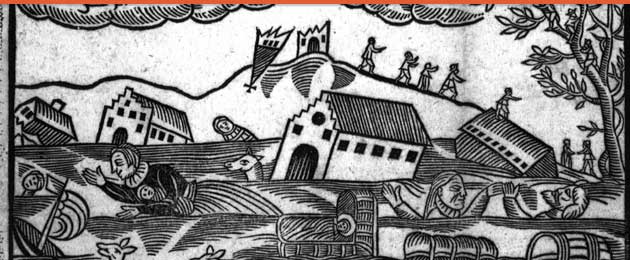 |
| Woodcut from broadsheet: "The Great and Terrible Flood," January 1651, from the Portal's Multimedia Library for environmental humanities |
As more exhibits go up and more multimedia are added, I think it's going to be an exciting place to get ideas and materials for teaching. The three navigation tools––map viewer, timeline, and keyword explorer––make it easy to make new and interesting connections across time and space. Just looking at this site has made me daydream about designing my own global environmental history class.
Anyway, I thought I would share this, since I'm not sure whether other HSM&T folks are aware of it. If you have found other websites useful for teaching (or ones you want to use in the future), or if you have specific ideas about how best to use a resource like this in the classroom, please share them in the comments! I'd love to have an ongoing discussion about this (happy hour, anyone?), but it would be nice to collect links here, as well.
 |
| The Keyword Explorer links to articles and multimedia throughout the Portal |
Friday, May 11, 2012
From Jungle to Rainforest
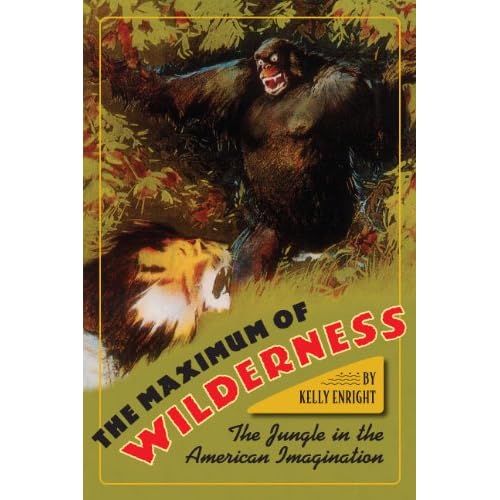 This is just a quick post to share my review of Kelly Enright's The Maximum of Wilderness: The Jungle in the American Imagination, which was just posted on H-Environment, H-Net Reviews.
Becoming an H-Net reviewer is easy, and I highly recommend it. (Academic journals have a variety of book review policies. It's best to check a journal's website and contact the book review editor if you have questions.) It took several months before I was contacted to write a review, so don't delay contacting the appropriate H-Net editor if you are interested.
Writing a book review can be a rewarding experience. It allows you to take part in current scholarly discussions more rapidly than through articles or books, yet more formally than through a blog like this one. In particular, because H-Net publishes online, there is a very quick turnaround time. I also find that reviewing a book is helpful for clarifying my own ideas about the field. Because you have a responsibility to give the book a very close reading and produce a fair account, the process helps you achieve a better sense of your own interests and approaches, in addition to a deep understanding of the work you review. Of course, you also get a free* book!
*Not counting the time you spend writing!
Tuesday, April 17, 2012
This Fine Place So Far From Home
I want to pass along a book recommendation from the Upper Midwest Regional Meeting of the American Academy of Religion, which I attended a couple of weeks ago in St. Paul. I've spoken before with a few classmates about the challenge of navigating the academy from a working-class background, and a colleague at AAR highly recommended this book, This Fine Place So Far from Home: Voices of Academics from the Working Class, edited by C. L. Barney Dews and Carolyn Leste Law:

I was struck by how many people at AAR identified as coming from the working class -- it was significantly more than I've ever noticed in a group of historians. All of us who identified ourselves seemed to be wrestling with the same issues of isolation and feeling out of place, which I had assumed I was feeling mostly because of being a gay man in the academy. Many of the issues of feeling at home in academia are in fact similar for working class and LGBTQ scholars.
Perhaps the most prominent issue the book addresses is the sense of being pulled between two worlds. For many of us from the working class, getting an advanced degree is a source of pride for our family, but also a source of estrangement, as we are pulled increasingly away from our origins. Also, it's not easy to explain the value of spending several years pursuing a doctorate, which is a puzzling and extravagant use of time to my family. My experience is that my two (or three) worlds hardly intersect at all, and so it takes a lot of energy to keep investing in such divergent relationships. I've heard bilingual friends speak about their experiences in this way, too.
Also addressed are the issues that probably most grad students wrestle with, of feeling an impostor in the world of the intellect. I notice how some grad students who grew up in academic families seem to move through the program with such familiarity -- not that it's easier for them intellectually or emotionally, but that they don't immediately assume that it's because they don't belong there. I think that the level of self-doubt has a different meaning for people who come from outside this sphere.
And one struggle that I know I've not hidden well is how awkwardly working-class behaviors and values fit into the academy. Not simply speaking plainly, but being blunter, even belligerent, using more profanity, and "playing the game" with less grace -- all contribute to the experience of being out of place.
I think that having a working-class background has motivated me to look at my research differently, and approach my teaching differently, but I'm looking forward to reading this book and being reminded that, despite our feelings of invisibility, that quite a few people who have to navigate that experience of being an outsider. I also look forward to talking more with all of you about these dynamics.

I was struck by how many people at AAR identified as coming from the working class -- it was significantly more than I've ever noticed in a group of historians. All of us who identified ourselves seemed to be wrestling with the same issues of isolation and feeling out of place, which I had assumed I was feeling mostly because of being a gay man in the academy. Many of the issues of feeling at home in academia are in fact similar for working class and LGBTQ scholars.
Perhaps the most prominent issue the book addresses is the sense of being pulled between two worlds. For many of us from the working class, getting an advanced degree is a source of pride for our family, but also a source of estrangement, as we are pulled increasingly away from our origins. Also, it's not easy to explain the value of spending several years pursuing a doctorate, which is a puzzling and extravagant use of time to my family. My experience is that my two (or three) worlds hardly intersect at all, and so it takes a lot of energy to keep investing in such divergent relationships. I've heard bilingual friends speak about their experiences in this way, too.
Also addressed are the issues that probably most grad students wrestle with, of feeling an impostor in the world of the intellect. I notice how some grad students who grew up in academic families seem to move through the program with such familiarity -- not that it's easier for them intellectually or emotionally, but that they don't immediately assume that it's because they don't belong there. I think that the level of self-doubt has a different meaning for people who come from outside this sphere.
And one struggle that I know I've not hidden well is how awkwardly working-class behaviors and values fit into the academy. Not simply speaking plainly, but being blunter, even belligerent, using more profanity, and "playing the game" with less grace -- all contribute to the experience of being out of place.
I think that having a working-class background has motivated me to look at my research differently, and approach my teaching differently, but I'm looking forward to reading this book and being reminded that, despite our feelings of invisibility, that quite a few people who have to navigate that experience of being an outsider. I also look forward to talking more with all of you about these dynamics.
Monday, April 16, 2012
Job Market Discussion
The History of Science brown bag for April 13th was an informal discussion on the job market, led by Alex Rudnick and Vicki Fama. We covered a lot of ground, but conversation focused primarily on the cover letter, teaching philosophy, the on-campus interview, and the value of post-docs. We mainly discussed issues that are pressing for students on or about to go on the market, but we hope to have future conversations about what one can do as a “younger” graduate student to prepare for the job search (Begin by reading this "The Professor Is In" post on the subject). Below is Meridith and Anna's summary of the sound advice doled out by our faculty:
Vicki started by noting that there is a lot of cynicism in the online dialogue about the job market. Certainly it's a tough market, but Mike Shank reminded us that it's been tight for historians of science for the last thirty years. So, what makes a strong application package? Mike was adamant (and other professors seemed to agree) that the cover letter is not only the first part of the application read, but can be a key means of weeding candidates out. It needs to be concise (no more than 2 pages), it should be addressed to the chair of the search committee, and it needs to be specific to the position that you're applying for. Tom Broman stressed the importance of being able to succinctly convey what your dissertation is about and show how your project can translate into future teaching and research. Judy Houck clarified that it's OK to have templates for cover letters; in fact, if you're applying to dozens of jobs (she applied to 100/year), you need to do this. For example, she created templates for positions in history of medicine, cultural history, and gender and women's studies. However, each letter should be tailored to the department in question, and should indicate how you fit the specific job, without being too defensive.
Anna Zeide asked about the types of positions one should apply to: is it wise to focus mainly on tenure-track (TT) jobs? Or is seeking transitional positions, like post-docs, a good strategy in some cases? Judy Houck said that it's typical for graduate students in the history of science and medicine to get post-docs before starting the TT search. She also pointed out that many of the alumni from our department who secured TT jobs right out of the program completed dissertations that were strongly relevant to fields beyond the history of science. One trend is that those who have done non-U.S. history have been more successful because of the far smaller pool of applicants. Mike Shank and Dayle DeLancey both felt post-docs are invaluable and are often the best strategy for everyone. Of course, there are different kinds of post-docs, but in general they can provide the opportunity for you to cut your teeth on teaching and work on publications. From the perspective of hiring committees, candidates with post-docs have been vetted by two institutions.
There seemed to be a fair amount of consensus that teaching philosophies are a fairly generic aspect of the package. They are normally not as tailored to a specific job as the cover letter, but it's good to mention courses offered in the department that you're prepared to teach. Judy Houck mentioned that when you're asked “How would you teach X,” people are often wondering what major works you would use in the class room, as opposed to your overall teaching style. The document itself should be broadly construed enough to demonstrate that you're flexible in your approach to teaching. Sue Lederer cautioned that one should not come off as someone who is SO committed to a certain kind of teaching philosophy that you appear unwilling to learn from future experience. She also said not to send the teaching philosophy unless an application explicitly asks for it. Andrew Stuhl pointed out that he aims to be a teacher first and foremost, so the teaching philosophy takes on greater importance as an element of the application package for students like him. He recommended the campus Writing Center's workshops on the teaching philosophy, and other elements of the application. As Anna Zeide nicely put it, it's an opportunity to express your voice and can be a “window into you.”
Finally, we discussed the on-campus interview. It's important to remember that the entire campus visit is an interview; dinners and causal conversations are just as crucial as talks or formal meetings. After all, the faculty is trying to decide whether or not you're someone that would make a good lifelong colleague. Generally one can expect to give a sample talk to the search committee and/or guest lecture an undergraduate course. You should treat these as chances to demonstrate your teaching abilities, not just discuss your research. Mike stressed that these are proxies for showing what kind of teacher you are: can you effectively teach the committee what your dissertation was about? Can you engage an audience? Judy noted that the interview process can be fun, as the focus is on you and your work, and that you're building connections with future colleagues, whether you end up in the position or not. However, you should also be prepared to ask questions of the faculty and make sure that you also show a sincere interest in your potential future work environment. Don't be too self-centered.
Micaela Sullivan-Fowler provided a piece of advice on the overall package: presentation matters. One should be make the effort to use high-quality paper, professional font, and pay attention to every detail.
Some final tips/ideas:
Other topics of interest that we didn't get to, that might be worth coming back to in future discussions or brownbags: when we should be publishing; how to talk to book editors; what kinds of job opportunities are out there beyond the R1 and small liberal arts colleges (re: the AHA conversations on "Plan B"); the possibility of setting up mock interviews in our department, like the History department does.
- What to do now:
- Read widely about the state of our profession: The Chronicle of Higher Education (available in the library or in the Medical History department, The Professor Is In, and other blogs.
- Do your best to make wide connections, even outside your university, but make sure any reference letters you have are written by people who really know your work, and can offer specifics.
- Teaching classes can help your research. It gives you a sense of where your work fits into a larger picture, and helps you transition your dissertation into a book.
- Have a website. Update it!
- Cover Letter:
- Search committees are looking at large stacks of applications, and are hoping to weed some out. You have to make the initial cut, so make your cover letter opening as strong as possible. Avoid vagueness.
- In your cover letter, describe how you will complement the current department, with specific reference to faculty.
- Send your cover letter draft around to faculty and colleagues for proofreading/editing before sending out the official version. Mike Shank says he's happy to read!
- Job Interviews
- Job interviews aren't all intellectual; the committee also wants to get to know you and to see whether they want to have you as a colleague for the foreseeable future.
- At a campus visit, be able to answer questions like, "What do you like to do in your spare time?" Your answer to this indicates whether your lifestyle would be a good fit for the city/town in which the university is located.
- Search committee doesn't typically offer feedback; as it isn't politic to do so.
- Fundamentally, the most important part of getting a job is what kind of scholar you are and how you package that. It's about the work (and some luck. and time.)
Subscribe to:
Posts (Atom)