Showing posts with label Visual Culture. Show all posts

Saturday, June 9, 2012

History of Science films of note: Isaac Newton, Zombie Hunter

No word yet on whether Shia Labeouf has been tapped for the role of Isaac Newton.

I guess historians of science like doing historical reenactments, like Captain Cook's 1768 expedition to observe the transit of Venus — but it's important to remember that we don't have a monopoly on doing history! According to The Hollywood Reporter, Rob Cohen, director of first Fast and the Furious and The Mummy 3: Tomb of the Dragon Emperor, will soon be teaming up with Rocky producer Gene Kirkwood to write and film a new movie based on Isaac Newton. Via The AV Club:
“Cohen's story will focus on Newton's later years as the head of the Royal Mint, with his film casting Newton as a ‘detective’—perhaps one aided by Newton's older partner John Locke, as sort of an Enlightenment-age Lethal Weapon—with Newton devoting himself primarily to hunting down counterfeiters (and, should Cohen show any interest in actual history, slowly falling apart thanks to a system ravaged by alchemy-provoked mercury poisoning). ”
I'm sure that after writing the Principia, Newton needed something better to do, but I kinda doubt that hanging out with a pain in the rear like John Locke was one of them. On the other hand, if this upcoming movie is anything like Troy, we might want to make this required viewing for undergrad SciRev classes — with a shot whenever Newton's heterodox religion gets cut out of the script, or at least whenever we get to see Brad Pitt's pecs.

sources: THR, The AV ClubLists of Note
image credit: National Geographic, The Michael Bayifier

Friday, May 18, 2012

Environment & Society Portal

If you're on the H-Environment listserv, you probably saw the recent announcement about the Environment & Society Portal's exhibit on Rachel Carson's Silent Spring. It is a beautiful exhibit, and it inspired me to finally take some time to explore the rest of the portal. All I can say is: wow. This is an incredible resource for teaching. 

Even if environmental history is not one of your primary interests, please check this site out. Many connections with the history of science, medicine, and technology are visible on the site, making it easy to imagine how to integrate some environmental history into a history of science class, and vice versa. 
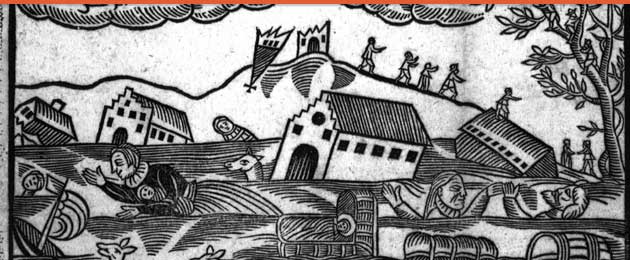
Woodcut from broadsheet: "The Great and Terrible Flood,"
January 1651, from the Portal's Multimedia Library for
environmental humanities

As more exhibits go up and more multimedia are added, I think it's going to be an exciting place to get ideas and materials for teaching. The three navigation tools––map viewer, timeline, and keyword explorer––make it easy to make new and interesting connections across time and space. Just looking at this site has made me daydream about designing my own global environmental history class. 

Anyway, I thought I would share this, since I'm not sure whether other HSM&T folks are aware of it. If you have found other websites useful for teaching (or ones you want to use in the future), or if you have specific ideas about how best to use a resource like this in the classroom, please share them in the comments! I'd love to have an ongoing discussion about this (happy hour, anyone?), but it would be nice to collect links here, as well. 
The Keyword Explorer links to articles
and multimedia throughout the Portal

Sunday, December 4, 2011

These Puttis aren't cuties...

Ugly Renaissance Babies!

(Now, go back to writing those final papers!)

Wednesday, October 26, 2011

Jesuits and the Construction of Knowledge, 1540–1773

I'm pleased, but a little late in announcing that an exhibit I co-curated with Dr. Florence Hsia, Dr. Robin Rider, and Dr. Jim Lattis has opened in Special Collections at Memorial Library. As the title suggests, the exhibit focuses on Jesuit and knowledge production from the order's establishment in 1540 to its repression in 1773. The disciplines commonly associated with the early Society like astronomy and mathematics are well represented, however we wanted to demonstrate the richness of early-modern Jesuit scholarship. As it turns out, we have a ton of rare books that could have been part of this exhibit and we ultimately had to make hard choices of what to include and exclude. The final display features over 100 works and includes a long list of books in our collections that didn't make the cut.

In helping select books for the exhibit, I really got a feel for the panoptic nature of early-modern Jesuit scholarship. As has often been said, the Jesuits were everywhere in the early modern world and the fruits of this globetrotting can be seen in their studies on hydrography, natural history, and cartography. The Society was clearly proud of the global nature of their mission, which is evidenced by the motto "unnus non sufficit orbis." Meaning "one world is not enough," this motto is inscribed in many engraved illustrations on display.

One particularly striking image in which it appears is a large map of the Society in the form of a tree. The trunk of the tree represents Rome, while the branches of the tree are the major missions of the world. A sundial clock is associated with each region of the world where the Jesuits were stationed, allowing the viewer to calculate the time difference between Rome and its provinces. Another one of my favorite images is a large, detailed selenography that appears in Riccioli's Almagestum novum (1651). Produced forty years after Galileo's telescopic study of the moon, much of Riccioli's lunar nomenclature has stuck. (Nick Jacobsen and I are hoping to produce a new interpretation of this image, possibly for HSS next year...)

None of these images can be adequately described in words and I've purposefully omitted links to images in order to encourage people to check out the exhibit, if possible. It will be up through December. However, I will be posting again about another related project: The Jesuit Iconography visual culture database.

Tuesday, July 19, 2011

UPDATE: Cat piano!


I recently posted about an image of what appeared to be an early-modern musical instrument that harnessed the vocal stylings of live animals. I had found the image in Gaspar Schott's 1657 Magia universalis at Memorial Library's Special Collections. I am still working on my Latin, so I was unclear whether or not this was actually a musical instrument. Turns out it was! The more popular form of which was the "cat organ" or "cat piano." In fact, this musical instrument has its own wikipedia page. As always, the truth is stranger than fiction.

Wednesday, June 22, 2011

Animal Keyboard from 1657


Remember those toy keyboards that would play animal sounds instead of musical notes? I remember being particularly fond of the MOO key on mine. Turns out the animal-sound-keyboard was not an invention of the 1980s, but is much more ancient in origin. Perhaps, first invented by the Jesuit polymath Gaspar Schott in 1657:

Clearly that's what's going on here, right? :)