The Chronicle of Higher Education, one of our resources for insight into the well-being (or lack) of the academic job market, is in the process of launching a new column, "Vitae," exploring the vicissitudes of the market and the professional skills needed to navigate it. A recent column "Advice for Graduate Students" provided a refreshing change of pace from the more detail-oriented articles about how to tailor your cover letter or how to strategize campus visits when you have childcare concerns, highlighting instead a big-picture state of mind that helps us keep our studies and research and job search in perspective.
One caveat: It would be easy to take the author's reflections as platitudes, but I think that she is offering an important observation, that our psychological well-being is an important part of our professional toolbox and appeal as a candidate. In our search for the minutiae that will help us nail down that dream job, it's easy to forget the bigger picture of the life of the mind, and the passion that drew us to graduate studies in the first place.
Showing posts with label professional development. Show all posts
Showing posts with label professional development. Show all posts
Tuesday, September 3, 2013

Saturday, June 9, 2012
History of Science films of note: Isaac Newton, Zombie Hunter

No word yet on whether Shia Labeouf has been tapped for the role of Isaac Newton.
I guess historians of science like doing historical reenactments, like Captain Cook's 1768 expedition to observe the transit of Venus — but it's important to remember that we don't have a monopoly on doing history! According to The Hollywood Reporter, Rob Cohen, director of first Fast and the Furious and The Mummy 3: Tomb of the Dragon Emperor, will soon be teaming up with Rocky producer Gene Kirkwood to write and film a new movie based on Isaac Newton. Via The AV Club:
I'm sure that after writing the Principia, Newton needed something better to do, but I kinda doubt that hanging out with a pain in the rear like John Locke was one of them. On the other hand, if this upcoming movie is anything like Troy, we might want to make this required viewing for undergrad SciRev classes — with a shot whenever Newton's heterodox religion gets cut out of the script, or at least whenever we get to see Brad Pitt's pecs.“Cohen's story will focus on Newton's later years as the head of the Royal Mint, with his film casting Newton as a ‘detective’—perhaps one aided by Newton's older partner John Locke, as sort of an Enlightenment-age Lethal Weapon—with Newton devoting himself primarily to hunting down counterfeiters (and, should Cohen show any interest in actual history, slowly falling apart thanks to a system ravaged by alchemy-provoked mercury poisoning). ”
sources: THR, The AV Club, Lists of Note
image credit: National Geographic, The Michael Bayifier
Friday, May 11, 2012
From Jungle to Rainforest
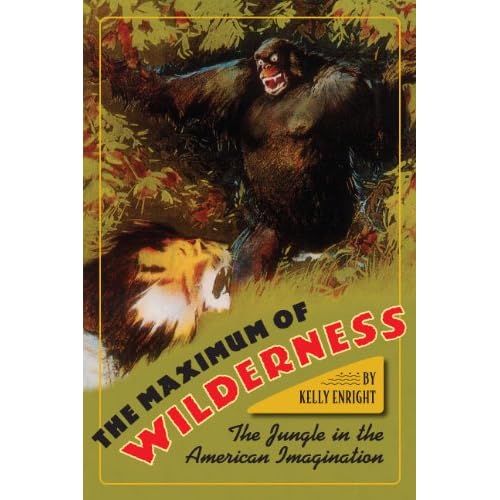 This is just a quick post to share my review of Kelly Enright's The Maximum of Wilderness: The Jungle in the American Imagination, which was just posted on H-Environment, H-Net Reviews.
Becoming an H-Net reviewer is easy, and I highly recommend it. (Academic journals have a variety of book review policies. It's best to check a journal's website and contact the book review editor if you have questions.) It took several months before I was contacted to write a review, so don't delay contacting the appropriate H-Net editor if you are interested.
Writing a book review can be a rewarding experience. It allows you to take part in current scholarly discussions more rapidly than through articles or books, yet more formally than through a blog like this one. In particular, because H-Net publishes online, there is a very quick turnaround time. I also find that reviewing a book is helpful for clarifying my own ideas about the field. Because you have a responsibility to give the book a very close reading and produce a fair account, the process helps you achieve a better sense of your own interests and approaches, in addition to a deep understanding of the work you review. Of course, you also get a free* book!
*Not counting the time you spend writing!
Monday, April 16, 2012
Job Market Discussion
The History of Science brown bag for April 13th was an informal discussion on the job market, led by Alex Rudnick and Vicki Fama. We covered a lot of ground, but conversation focused primarily on the cover letter, teaching philosophy, the on-campus interview, and the value of post-docs. We mainly discussed issues that are pressing for students on or about to go on the market, but we hope to have future conversations about what one can do as a “younger” graduate student to prepare for the job search (Begin by reading this "The Professor Is In" post on the subject). Below is Meridith and Anna's summary of the sound advice doled out by our faculty:
Vicki started by noting that there is a lot of cynicism in the online dialogue about the job market. Certainly it's a tough market, but Mike Shank reminded us that it's been tight for historians of science for the last thirty years. So, what makes a strong application package? Mike was adamant (and other professors seemed to agree) that the cover letter is not only the first part of the application read, but can be a key means of weeding candidates out. It needs to be concise (no more than 2 pages), it should be addressed to the chair of the search committee, and it needs to be specific to the position that you're applying for. Tom Broman stressed the importance of being able to succinctly convey what your dissertation is about and show how your project can translate into future teaching and research. Judy Houck clarified that it's OK to have templates for cover letters; in fact, if you're applying to dozens of jobs (she applied to 100/year), you need to do this. For example, she created templates for positions in history of medicine, cultural history, and gender and women's studies. However, each letter should be tailored to the department in question, and should indicate how you fit the specific job, without being too defensive.
Anna Zeide asked about the types of positions one should apply to: is it wise to focus mainly on tenure-track (TT) jobs? Or is seeking transitional positions, like post-docs, a good strategy in some cases? Judy Houck said that it's typical for graduate students in the history of science and medicine to get post-docs before starting the TT search. She also pointed out that many of the alumni from our department who secured TT jobs right out of the program completed dissertations that were strongly relevant to fields beyond the history of science. One trend is that those who have done non-U.S. history have been more successful because of the far smaller pool of applicants. Mike Shank and Dayle DeLancey both felt post-docs are invaluable and are often the best strategy for everyone. Of course, there are different kinds of post-docs, but in general they can provide the opportunity for you to cut your teeth on teaching and work on publications. From the perspective of hiring committees, candidates with post-docs have been vetted by two institutions.
There seemed to be a fair amount of consensus that teaching philosophies are a fairly generic aspect of the package. They are normally not as tailored to a specific job as the cover letter, but it's good to mention courses offered in the department that you're prepared to teach. Judy Houck mentioned that when you're asked “How would you teach X,” people are often wondering what major works you would use in the class room, as opposed to your overall teaching style. The document itself should be broadly construed enough to demonstrate that you're flexible in your approach to teaching. Sue Lederer cautioned that one should not come off as someone who is SO committed to a certain kind of teaching philosophy that you appear unwilling to learn from future experience. She also said not to send the teaching philosophy unless an application explicitly asks for it. Andrew Stuhl pointed out that he aims to be a teacher first and foremost, so the teaching philosophy takes on greater importance as an element of the application package for students like him. He recommended the campus Writing Center's workshops on the teaching philosophy, and other elements of the application. As Anna Zeide nicely put it, it's an opportunity to express your voice and can be a “window into you.”
Finally, we discussed the on-campus interview. It's important to remember that the entire campus visit is an interview; dinners and causal conversations are just as crucial as talks or formal meetings. After all, the faculty is trying to decide whether or not you're someone that would make a good lifelong colleague. Generally one can expect to give a sample talk to the search committee and/or guest lecture an undergraduate course. You should treat these as chances to demonstrate your teaching abilities, not just discuss your research. Mike stressed that these are proxies for showing what kind of teacher you are: can you effectively teach the committee what your dissertation was about? Can you engage an audience? Judy noted that the interview process can be fun, as the focus is on you and your work, and that you're building connections with future colleagues, whether you end up in the position or not. However, you should also be prepared to ask questions of the faculty and make sure that you also show a sincere interest in your potential future work environment. Don't be too self-centered.
Micaela Sullivan-Fowler provided a piece of advice on the overall package: presentation matters. One should be make the effort to use high-quality paper, professional font, and pay attention to every detail.
Some final tips/ideas:
Other topics of interest that we didn't get to, that might be worth coming back to in future discussions or brownbags: when we should be publishing; how to talk to book editors; what kinds of job opportunities are out there beyond the R1 and small liberal arts colleges (re: the AHA conversations on "Plan B"); the possibility of setting up mock interviews in our department, like the History department does.
- What to do now:
- Read widely about the state of our profession: The Chronicle of Higher Education (available in the library or in the Medical History department, The Professor Is In, and other blogs.
- Do your best to make wide connections, even outside your university, but make sure any reference letters you have are written by people who really know your work, and can offer specifics.
- Teaching classes can help your research. It gives you a sense of where your work fits into a larger picture, and helps you transition your dissertation into a book.
- Have a website. Update it!
- Cover Letter:
- Search committees are looking at large stacks of applications, and are hoping to weed some out. You have to make the initial cut, so make your cover letter opening as strong as possible. Avoid vagueness.
- In your cover letter, describe how you will complement the current department, with specific reference to faculty.
- Send your cover letter draft around to faculty and colleagues for proofreading/editing before sending out the official version. Mike Shank says he's happy to read!
- Job Interviews
- Job interviews aren't all intellectual; the committee also wants to get to know you and to see whether they want to have you as a colleague for the foreseeable future.
- At a campus visit, be able to answer questions like, "What do you like to do in your spare time?" Your answer to this indicates whether your lifestyle would be a good fit for the city/town in which the university is located.
- Search committee doesn't typically offer feedback; as it isn't politic to do so.
- Fundamentally, the most important part of getting a job is what kind of scholar you are and how you package that. It's about the work (and some luck. and time.)
Friday, April 13, 2012
Getting the Most Out of Regional Conferences
One of the points raised in today’s excellent Brown Bag conversation about preparing for the job market was what we can do early in our program to prepare us – professionally and mentally – for a career in scholarship.
Of course, the first resource I want to share is The Professor Is In, a superlative blog about how to be sane and successful in the academic world, and which includes this especially helpful post: What To Do Now in Grad School.
The piece of advice I want to share is how valuable it is to attend small conferences and parlay these baby steps into giant professional steps. During back-to-back weekends, I attended Junto, the Midwest regional meeting of the History of Science Society, and the Upper Midwest regional meeting of the American Academy of Religion. Both were very welcoming to newcomers and were intentional about not intimidating those of us who were new to giving conference presentations. In fact, I urge you to get next year’s Junto on your calendar right now, and start saving those pennies to get yourself there:
Junto 2013: April 5-7 in Notre Dame, Indiana
(Incidentally, Wisconsin hosted the first Junto back in 1964, and it’s been several years since it met here, so I believe that it’s time we offered Madison hospitality for the 2014 Junto – who’s with me?)
Both Junto and the regional meeting of the AAR are intended to be low-key opportunities especially for newbies, so definitely take advantage of these conferences. They will make it much easier to imagine yourself presenting at the History of Science Society or even the American Historical Association, and then in your first job talks and teaching demonstrations. Take a stack of business cards to hand out -- after all, these are your future colleagues you're rubbing elbows with.
However, I would also like to offer some advice to inexperienced speakers about presenting effectively and making the most of these smaller, less-intimidating conferences.
1. Write in your speaking voice. Most importantly, remember that you are presenting to be understood. That sounds deceptively obvious, but quite a few of the presenters at both conferences did not do a good job of making themselves understood. First of all, recognize that there is a difference between your writing voice and your speaking voice – your audience is not going to have a copy of your text in front of them, and so they’re depending on you to be clear and easy to follow. Write a brilliant paper, by all means, but then go back through and rewrite it into your speaking voice. Cut down on the long-winded and complex-compound sentences, eliminate jargon and abbreviations, signpost your important points scrupulously, be lively and expressive, and use pauses to make yourself more understandable. I cannot emphasize this last point enough; I am convinced that the good response I got from the audience last week was primarily because they could actually understand what I was saying. In our nervousness, we might produce something like this information overload:
ThismorningI’mexaminingtheprovocationofarangeofAmericanresponsestothe1829textbookIntroductiontoGeologybyBenjaminSillimanSr.
which, to the audience, feels a bit like the famous scene from I Love Lucy:

Audience members need a moment to digest each chunk of information before the next one comes along, and if you don’t give it to them, they’re not following you. Better would be something like this:
This morning I’m examining (tiny pause) the provocation of a range of American responses (tiny pause) to the 1829 textbook (tiny pause) Introduction to Geology (tiny pause) by Benjamin Silliman Sr. (bigger pause)
Rehearse your talk several times, if possible, before the conference itself, and get some practice at using these pauses. If necessary, put a slash / at each place in your text / that you want to pause. Having sat through an entire day of twenty-minute presentations during which I believe no one actually paused to take a breath, I guarantee that your audience will thank you.
2. Respect the time limit. Seriously – no exceptions. One of the reasons you must rehearse your talk in advance is to make sure that you finish within the time limit with time to spare. DO NOT TRY TO FIT A 20-MINUTE TALK INTO 15 MINUTES – the only thing you will accomplish is to guarantee that your audience cannot follow you. Giving just the core points of your research and finishing with time for questions demonstrates not only that you respect your audience and the organizers, but also that you know your topic well enough to articulate what the very essence of it is. Being an experienced public speaker, I know that I can speak at 150 words per minute, but that 110 words per minute is much easier to understand. When the time limit is 20 minutes, I strive to write 17 minutes of speech, and then very deliberately make sure that I’m adding pauses for emphasis and clarity. Again, give yourself lots of chances to rehearse beforehand to be sure.
3. PowerPoint is a privilege, not a right. We’ve all seen examples of PowerPoint used badly, right? Cluttered slides, eye-searing neon text and ornate fonts, cutesy special effects – there are so many ways in which this can go wrong, but it also means that PowerPoint done well will stand out. First of all, recognize that every new slide distracts the audience from following what you’re saying, so don’t overwhelm them with unnecessary clip art or entertaining effects, and pause while they digest it and return their attention to you. I was so frustrated by a presenter last week, who apparently was trying to win a bet that he could use every single special effect offered by PowerPoint, that I could scarcely follow what he was saying. And don’t put any more text up there than absolutely necessary, but just the basic messages that you want to make sure the audience is getting – again, this is an exercise in demonstrating that you can articulate what the core of your research is. Lastly, remember that this visual medium is most effective when it’s contributing visual content – faces, maps, and landscapes -- that help to balance out all of the words the audience is already digesting.
4. Speak clearly, or speak not. Yes, public speaking is an anxious experience for us all. I preach almost weekly, and I still get nervous when I present at conferences. Everyone is sympathetic with you about how stressful this is, but that’s no excuse to become inaudible. Pitch your voice to the very back row, breathe so that you can project, enunciate clearly and speak expressively, and you will have already distinguished yourself from 80% of the other presenters. If you will be using a microphone, ask to test it during the break, and make sure that you can be heard. This is not Hogwarts, where the Sonorus spell will make sure that you’re audible – you have to actually speak into the microphone for it to work. And don’t bury your head in your manuscript text; look at your audience. I’m astounded at how many academics, who make a living by speaking to rooms full of people, are unable to speak to a room full of people. Make sure that you can be heard, or all your hard work will go unappreciated.
5. Your enthusiasm is contagious. Yeah, this sounds like new-age thinking, I know, but seriously – if you convey your excitement for your topic and are explicit about why it should also be interesting to your audience, they’ll pick up on your enthusiasm. One of the most memorable talks I heard last week was about a history-of-technology analysis of the steampunk genre – maybe not the most serious topic, but it was fun and cheeky, and the presenter’s playfulness made it enjoyable for the audience as well. Sadly, the converse is also true – if you seem bored, frustrated, or confused by your topic, the audience will be too. Your posture, eye contact, changing pitch and cadence of your voice, and gestures all help to animate your talk, so get some practice at using them – alone at home, in front of a mirror, before a small group of trusted colleagues – and you’ll feel more natural using them at the conference.
Okay, these are just a few of the basic tips that came to mind during these two great conferences. What suggestions can you add to this list?
Friday, October 7, 2011
Historical Methods & Resources For the Greenhorn Historian
Dear HSMTers (and their fans),
I have compiled a list of all the books and resources that I have found to be particularly helpful for learning historical methods and teaching. I also included a section on managing the lifestyle of being a graduate student and budding scholar. These resources may be a little basic, but they might be helpful for those with little or no historical or pedagogical training.

Books:
Becker, Howard Saul, and Pamela Richards. Writing for Social Scientists : How to Start and Finish Your Thesis, Book, or Article. 2nd ed, Chicago Guides to Writing, Editing, and Publishing. Chicago: University of Chicago Press, 2007.
Booth, Wayne C., Gregory G. Colomb, and Joseph M. Williams. The Craft of Research. 3rd ed, Chicago Guides to Writing, Editing, and Publishing. Chicago: University of Chicago Press, 2008.
Chandler, James, Arnold I. Davidson, and Harry D. Harootunian. Questions of Evidence : Proof, Practice, and Persuasion across the Disciplines. Chicago: University of Chicago Press, 1994.
Davidson, James West, and Mark H. Lytle. After the Fact : The Art of Historical Detection. 2 vols. New York: Knopf, 1982.
Grafton, Anthony. The Footnote : A Curious History. [Rev. ed. Cambridge, Mass.: Harvard University Press, 1997.
Jordanova, L.J., and LJ Jordanova. History in Practice: Arnold London, 2000.
Murray, Rowena. "Writing for Academic Journals." Maidenhead: McGraw-Hill International (UK) Ltd, 2009.
Rampolla, Mary Lynn. A Pocket Guide to Writing in History. 6th ed. Boston: Bedford/St. Martin's, 2010.
Rosen, Leonard J. The Academic Writer's Handbook. 3rd ed. Boston: Pearson Longman, 2012.
Tosh, John. The Pursuit of History : Aims, Methods and New Directions in the Study of Modern History. 5th ed. Harlow, England ; New York: Longman, 2010.
Turabian, Kate L., John Grossman, and Alice Bennett. A Manual for Writers of Term Papers, Theses, and Dissertations. 6th ed, Chicago Guides to Writing, Editing, and Publishing. Chicago: University of Chicago Press, 1996.
Research:
Perspectives on History: Finding the Story
On Taking Notes
Managing the Terror
How Writing Leads to Thinking (And not the other way around)
"Building a Mystery":Alternative Research Writing and the Academic Act of Seeking
Web 2.0 A Useful Tool for the History of Medicine (and Science and Technology...)
Teaching:
What Does it Mean to Think Historically?
Learning Historical Research
http://www.williamcronon.net/researching/index.htmLapham’s Quarterly Lesson Plans/Handouts
Helpful hints for deciding “What is happening?” and “Where do I stand?”
Teaching/Writing Handouts
Digital Resources:
UW Database Library: History of Science, Medicine, Technology
Directory of History Journals
University of Wisconsin Digital Collections Center
Archival Resources in Wisconsin: Descriptive Finding Aids
The Knight Digital Media Center and Source Guides
Wisconsin Division for Libraries, Technology, and Community Learning: BadgerLink
Oral History Tools
Historical 'Hardware':
Transcriptions: Transcribing Audio to Text Software Aid (for Mac only)
Chicago Manual of Style Crib Sheet
RefWorks/EndNote/Zotero Features Comparison
All Bookstores Search Engine
Internet Disablers
Mac Applications Disabler
Desktop Screen Darkener
Free Trainings & Workshops:
Library Workshops: Historical Research
Library Workshops: Graduate Support Series
Library and Information Literacy Instruction
Writing Center Workshops
Software Training Workshops by DoIT
For Inspiration:
Why Become a Historian?
Why Study History?
Why the Past Matters
Advice Against Despair: Caring for the Whole ... and for Ourselves:
Professional Development:
Campus Humanities Portal
Grad School Survival
Scholarly Pursuits: A Guide to Professional Development During the Graduate Years
Publishing Without Perishing: A Handbook for Graduate and Professional Students
Graduate Student Professional Development Career Planning
The Professor Is In
Careers for History Majors
How to Find a Job Outside of Academia, Even if You Aren't Sure That You Want One
Friday, September 30, 2011
The Academic Job Search Handbook

I just got a copy of The academic Job Search Handbook (2008, 4th ed.) by Julia Miller Vick and Jennifer S. Furlong. Wow. I wish I'd known about this earlier.
Not only does it include a timetable for planning job searches, but it has examples of vitas, cover letters, teaching philosophies, etc. There are also discussions of the job interview, and strategies for job searching when your partner is also an academic. I haven't read the whole thing yet, and I realize that it is not tailored to our particular discipline, but it looks like a great way to get familiarized with the general process in a way that is not overly intimidating.
I ILLed it, as the on-campus copies apparently don't allow borrowing privileges. You can preview it at Google Books.
Have any of you come across this before and have any opinions about it before I dive completely in? As far as I know, there's not another book like this (though many online discussions of similar topics).
Wednesday, September 14, 2011
Workshops
Two posts? I guess I am on a roll today...
I just signed up for some Writing Center workshops on preparing material for the job market (cover letters, statements of teaching philosophy, etc.). I'm not sure if you folks are aware of all the workshops like this that are available on campus, so here's a round-up:
Maybe I will see you there?
Writing Your Dissertation
If you know me, you know I am not normally a big "self help" literature fan. But over the summer, as I set out with a goal of writing my first two dissertation chapters, I felt I needed some advice managing such a big and emotionally draining project. Several other current or recent dissertators suggested the following three books, which I have found incredibly helpful:


Writing Down the Bones by Natalie Goldberg (And, thanks to Christine Manganero for recommending this.)
Writing Your Dissertation in Fifteen Minutes a Day by Joan Bolker (Thanks Lynnette Regouby for lending this to me for so long awhile back. I'm now hogging the library's copy, but all of you should feel free to recall it!)
Bird by Bird and Writing Down the Bones are both directed at fiction writers, but much of the advice still applies. The practical and psychological issues around creativity, self-doubt, and discipline apply equally to fiction and non-fiction writers. Both of these books helped me feel like a writer, not like a person who had to produce a dissertation.
Writing Your Dissertation in Fifteen Minutes a Day is more obviously and directly relevant to the specific process of dissertation writing, from choosing a topic and selecting a committee, to finishing and publication. But this is a book by a psychologist, and it's at its best when confronting the emotional aspects of the process––including sections such as "On Ownership," "On Dissertation Paranoia," and "About Creating a Writing Addiction."
The only drawback of these three books is that they are getting to be quite a bit old. They don't discuss software, like Scrivener for example, that can help organize notes and "shitty first draft" writing. Nor do they address the specific problems of internet procrastination (including wasting time searching for new "productivity" software!).
Nevertheless, they still get at the heart of the writing process and can really help you avoid, or at least deal with, some of the roadblocks you encounter when setting out to write. And, in spite of their very different styles, all three books have the same core message: Make writing a part of who you are. Make it part of your day, every day. If you do this, you will have before you not one huge insurmountable task, but a daily practice (or addiction even!) of writing.
Do you have any other reading suggestions for writers?
Subscribe to:
Posts (Atom)